
8 Days Cheptegei Peak Rwenzori Trekking -Kilembe
This 8-day trek to Cheptegei Peak (4,907m) via the Kelembe trail (Southern Circuit) provides a wonderful opportunity to explore the diverse and stunning landscapes of the Rwenzori Mountains. Starting from Nyakalengija Base Camp, the path gently climbs through lush Afro-montane forest, bamboo areas, alpine valleys, and high-altitude glacial landscapes, leading to one of the most rewarding summits in the range.
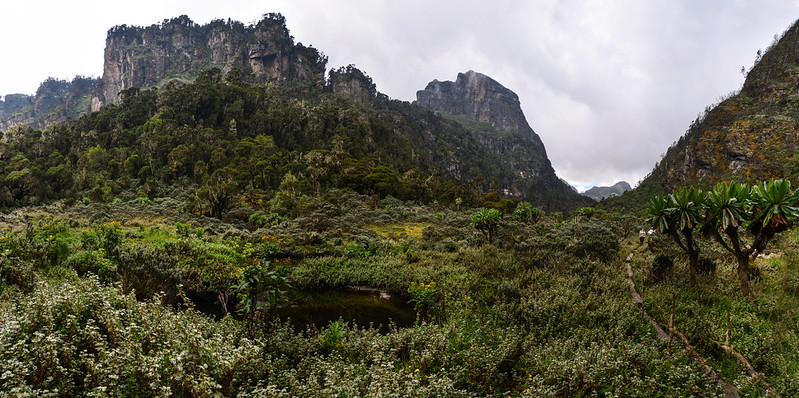
The Rwenzori trekking To Cheptegei Peak is thoughtfully planned for a smooth acclimatization process, featuring beautiful camps set at higher elevations. You will get to enjoy an amazing range of ecosystems, from lush, moss-covered forests bustling with primates and vibrant birdlife to stunning alpine areas filled with giant lobelias, groundsels, and beautiful glacial lakes. Some of the wonderful highlights are Enock’s Falls, Lake Kitandara, Bamwanjarra Pass, and the stunning views of Mount Stanley, Mount Baker, and Mount Speke.
Summit day includes a glacier crossing and a brief non-technical scramble, making Cheptegei Peak attainable for trekkers who are well-prepared and in good shape. The descent takes you through different valleys, showcasing fresh views of the mountains before looping back through the beautiful Nyamwamba Valley.
Trip highlights For 8 Days Rwenzori Trekking to Cheptegei Peak
Day 1: Hike to Sine Camp 2596 metres.
Day 2: Hike to Mutinda Camp 3588metres.
Day 3: Hike to Bugata Camp 4100metres.
Day 4: Hike to Hunwicks Camp 3974metres.
Day 5: Hike to Margherita camp 4485 metres.
Day 6: Summit Cheptegei peak 4907 metres.
Day 7: Descend down to Kiharo Camp 3430metres.
Day 8: Descend down to the Base camp 1450metres.
Detailed itinerary for the 8 Days Rwenzori Cheptegei Peak via the Southern Circuit
Day 1: Hike to Sine Camp (2,596m)
The walk starts at Nyakalengija Base Camp and goes along the valley floor through the tall trees of the Afro-montane Forest Zone. The climb is steady and beautiful, and there are many different kinds of birds. You can often see blue monkeys and black-and-white colobus monkeys swinging through the sky.
The forest is thick with trunks covered in moss, vines that hang down, bamboo thickets, fungi, and flowering bushes. During your trek you might hear chimpanzees calling in the background.
Before you get to camp, a short walk will take you to Enock’s Falls. The falls go through thick green plants and are a great place to take pictures. Sine Camp (2,596m) is on a narrow hill with a big waterfall below it. The ridge is surrounded by tall trees. At night, we often sit around the campfire, tell stories with guides, and enjoy the quiet forest vibe.
Day 2: Hike to Mutinda Camp (3,588m)
Your trek starts at about 8:30 a.m., after breakfast. The path goes into the Bamboo Mimulopsis Zone, a steep part with big steps, almost right away. This area can get muddy and slippery in the wet season. This makes progress slower but adds to the excitement.
You will get to Kalalama Camp after climbing up the bamboo forest. You can take a short break there before you keep going. The trail then follows the tops of hills and into valleys. It goes over small streams and past waterfalls with moss while going under heather trees that are covered in lichen.
The hike goes on through a deep valley full of fog and plants and mountain flowers. In the afternoon, a walk to Mutinda Lookout (3,975m) is available to those who want to get used to the area. The lookout has amazing views of the Rwenzori range, the town of Kasese, and Lake George.
Day 3: Hike to Bugata Camp (4,100m)
This hike goes through the Mutinda Valley, which is known for its tussock grass, eternal flowers, and tall giant lobelias. The trail is often muddy, especially when it’s wet, but it’s not too hard to get across if you step carefully from tussock to tussock.
Sheer waterfalls fall down the sides of the Namusangi Valley (3,840 m), which is reached by a steep walk. If you look back, you can see the beautiful Mutinda Peaks.
As the path goes up to Bugata Camp (4,100m), which is high up among alpine plants, the valley moves gently.
Day 4: Hike to Hunwick’s Camp (3,974m) via Bamwanjarra Pass
The path goes up to Bamwanjarra Pass (4,450m) after leaving Bugata Camp. If the weather gets bad, there is a safety hut at the pass where people can stay safe. When the sky is clear, the pass has great views of Mount Stanley, Mount Baker, and Mount Speke.
From the pass, the path goes down a little through muddy ground that has a lot of moss, giant groundsels, and lobelias. The Malachite Sunbird lives on lobelia flowers. It is one of the best spots in the Rwenzori to see this bird.
The road goes up gently to Hunwick’s Camp after some steep parts. The camp is found above a deep valley, with great views of the tall mountains nearby.
Day 5: Hike to Margherita Camp (4,485m)
You will hike from Hunwick’s Camp and go down to the valley floor where you will then across to Lake Kitandara, which is beautiful and alpine and one of the Rwenzori Mountains‘ best scenic lakes. From the lake, the path goes straight up Scott Elliot Pass and then up to Margherita Camp (4,485m). The camp is in the middle of big mountains that protect it from strong high winds.
The camp is historically important since it’s where the Duke of Abruzzi set up camp in 1906 while he was the first person to climb Margherita Peak.
Day 6: Summit Cheptegei Peak (4,907m) & Return to Hunwick’s Camp
This hike starts early, usually between 4:30 and 5:30 a.m. and this makes it easier to get the best conditions at the top. From the bottom of the Stanley Glacier, you go up to the middle of it and then turn left toward Cheptegei Peak. When you get to the viewpoint, you are on rocky ground. A short, non-technical rock climb comes next. The thin air at high altitude makes it slower. The top of Cheptegei Peak (4,907 m), offer stunning views of Uganda and Congo, as well as beautiful views of Alexandra Peak, Margherita Peak, Mount Speke, the Bujuku Valley, and the Stanley Glaciers below. After reaching the peak, you go straight back down to Hunwick’s Camp.
Day 7: Descend to Kiharo Camp (3,430m)
Today’s drop goes down along the high peaks and low points that were shaped by glaciers long ago. As you drop altitude, the landscape slowly becomes softer, and the rocks are replaced by green plants that grow in the mountains.
The trail goes through mossy wetlands, steep hills, and thick plants before it gets to Kiharo Camp. The camp is in the middle of a valley that is bordered by tall cliffs and a forest.
Day 8: Descend to Base Camp (1,450m)
The last day goes down the beautiful Nyamwamba Valley, which is thought to be one of the prettiest parts of the Rwenzori Mountains. The trail goes along the river past rocks with moss on them, waterfalls, and thick forest in the mountains. Rwenzori red duikers may be quietly eating in forest clearings. The road goes past a lot of waterfalls and cliffs that were made by glaciers a long time ago. It then goes through a thick forest and back to Nyakalengija Base Camp (1,450 m).
Tour Inclusion
- Ruwenzori days
- Accommodation and meals on full board on the mountain
- English speak guide
- Park entrance
- Ice climbing equipment (ice axe, crampons, helmet, harness and ropes
- As well as gumboots
- Accommodation on the mountain
- Meals as you hike
- 2 ranger guides
- 2 porters per person
- Cheff/cook
Tour exclusion
- All personal expenses